
Manga,Anime and Video Games Fan!
Monday, 25 October 2010
Yesterday
Right, I forgot to write this yesterday. I joined a math competition. Didn't do so well. Oh well.

Wednesday, 20 October 2010
Resident Evil 4
Right, actually I already finished the main game. Bought it a few days ago. I'll write the story later on. I started The Mercenaries Mode. Quite hard. Also tried a mode called Separate Ways. Finished it as well. Well, that's all I'll write for now. More on the main story next time.
Monday, 18 October 2010
New Games
Right, I bought new games, Resident Evil 4 and Star Ocean:Till The End Of Time. I already started on RE4, so I'll be writing about it in the future.
Sunday, 17 October 2010
Mid Terms, 5th Day
Well actually, it was 2 days ago. I'm just writing about it. It was Math and TIK(Teknologi Informasi Komunikasi or Information Communication Technology). Not much problem with Math, just not careful. Beside that, nothing else.
Thursday, 14 October 2010
Mid Terms, 4th Day
Right, today was Indonesia and Arts. Nothing interesting during Indonesia, but there was a big problem in Arts. It was the wrong materials. In the previous day, a teacher came up to me and asked what grade those questions were supposed to be for. After taking a quick glimpse at the book, me and the teacher thought it was for Grade 9. Turns out, it's for Grade 7. So I might be responsible for the whole of Grade 9's Arts grades.
Wednesday, 13 October 2010
Mid Terms, 3rd Day
Third day, English and PLKJ(Pendidikan Lingkungan Kehidupan Jakarta or Jakarta.Environment Education). The pictures in English weren't clear, so it was hard. Beside that, nothing else interesting.
Tuesday, 12 October 2010
Mid Terms, 2nd Day
Second day of mid terms. Today was Social Studies and Civics. Social Studies was a bit hard, but Civics was quite easy. Fortunately, the teacher who was watching over during Social Studies was not so strict, so cooperation easy.
Monday, 11 October 2010
Mid Terms, 1st Day
First day during my mid term exams. Science and Religion. Science was a little bit hard, but Religon wasn't. I have no idea why I help my classmates. I rarely get benefits out of it and it's not exactly the right thing to do. Well, in Religion, there was a slight problem. There were 2 no. 47, so it wasn't known whether there's 51 or 50 questions.
Well, that's about it. I'll write more about the other mid tests.
Well, that's about it. I'll write more about the other mid tests.
Tuesday, 5 October 2010
Resident Evil 4: Afterlife
SPOILERS ALERT!
I'm writing the storyline as well, so read at yor own discretion.
There's a lot of action, cool fighting and according to my brother(and Wikipedia) there's the Axeman. From what I know, that's a boss in one of the Resident Evil games. Sorry if I'm wrong.Anyways, it took elements from the games, notably Resident Evil 5 when Wesker battles Chris and Claire(Sheva in the game), my favorite. Well, I don,t have much time, so I'll copy paste from Wikipedia. Credits goes to it and sorry.
After the events of Resident Evil: Extinction, the Alice clones (Milla Jovovich) attempt to kill Albert Wesker (Shawn Roberts) at his base in Japan. All present clones are killed in an explosion, as Wesker escapes in an aircraft. The original Alice ambushes him, but Wesker injects her with a serum that neutralizes the T-virus in her system, eliminating her superhuman powers and making her human again. He reveals that his T-Virus powers have surpassed her own, but before he can kill her, the aircraft crashes and Alice emerges from the wreckage.Six months later, Alice follows a repeating emergency broadcast from a survivors' safe haven known as "Arcadia" in Alaska. After many fruitless months searching for Arcadia and finding no survivors along the way, including her friends Claire Redfield (Ali Larter) and K-Mart (Spencer Locke), Alice begins to lose hope, believing herself to be the last surviving human on the planet. Stopping on an abandoned beach, Alice finds the helicopter taken by Claire and the others when they and Alice parted ways. A crazed Claire, under the influence of an Umbrella Corporation device attached to her chest, attacks her. Alice removes the device, finding that it has damaged Claire's memory, which she slowly regains.
Flying a two-person plane, they enter the ruins of Los Angeles and find a small group of survivors, led by Luther West (Boris Kodjoe) living in a maximum security prison, surrounded by the undead. Alice crash lands the plane on the roof of the prison and learn that Arcadia is not a fixed place but actually a cargo tanker traveling along the coast. Since the plane cannot take more than two, Alice and the survivors try to figure out a means to make it to Arcadia together. The survivors have been keeping watch on a prisoner, Chris (Wentworth Miller), whom they found locked in a maximum security cell when they arrived. He says that he is a soldier who fought the early outbreak, but was locked up by prisoners as a cruel joke when the mission failed and knows a way to reach the coast, and thereby Arcadia, but will not reveal it unless he is released.
They do not believe him, and keep him locked up until the undead manage to tunnel through the sewer ways and up into the prison, and a giant axe wielding Nemesis monster starts to break down the front gate; Alice and survivors are out of time to find a means to reach Arcadia so they decide to free Chris and use his escape route. He recognizes Claire and reveals himself as her brother, though she does not remember him. Chris' proposed method, a stored military vehicle, is legitimate, but the vehicle is not operational and they are left with no other option but to use the tunnel to escape through the sewers, and storm drains which empty at the coast. The group fights their way out — Alice, Claire, and Chris manage to escape into the sewers.
They continue to Arcadia, finding the ship completely functional, but abandoned. Exploring its inner depths, they realize that it is a trap set by Umbrella to lure survivors to the ship to conduct experiments on them. Claire now remembers what happened to her group when they arrived to Alaska: Umbrella ambushed their group when they landed on the beach, attaching the devices to them, though she managed to escape. They release the survivors, among them K-Mart, and Alice continues deeper into the ship, finding escape helicopters and a purging bomb. Deeper inward, she finds Wesker, who explains the price of his survival, is a war within himself for control against the T-Virus. By assimilating Alice, the only individual to bond successfully with the T-virus, he might be able to gain full mastery of it. At this point the crew of the ship had abandoned Wesker, terrified by his cannibalism.
Chris, Claire, and Alice battle the super-powered Wesker and seemingly kill him with help from a recovered K-Mart. Wesker does not die, but regenerate and escapes on a helicopter. He activates the purge bomb on the Arcadia in attempt to destroy the ship and kill the remaining survivors. Anticipating his actions Alice had hidden the bomb on board the helicopter, which is destroyed by the explosion. Alice, Claire, and Chris watch the destruction from the deck of the Arcadia.
Alice resolves to turn Arcadia into a real safe haven and broadcasts its message for any other survivors. As Claire, Chris, and Alice decide how to proceed with all the survivors, they see an approaching Umbrella assault fleet led by Jill Valentine (Sienna Guillory), who is under the control of the same Umbrella device used on Claire.
That Jill thing is really a clip hanger. Oh well, hope they have a Resident Evil 5.
Sunday, 3 October 2010
Network Topology 2
My second part. Since I need 5, but I only got 3 in the previous post due to not enough time, I'll add at least 2 more. Here they are.
4. Mesh Networking
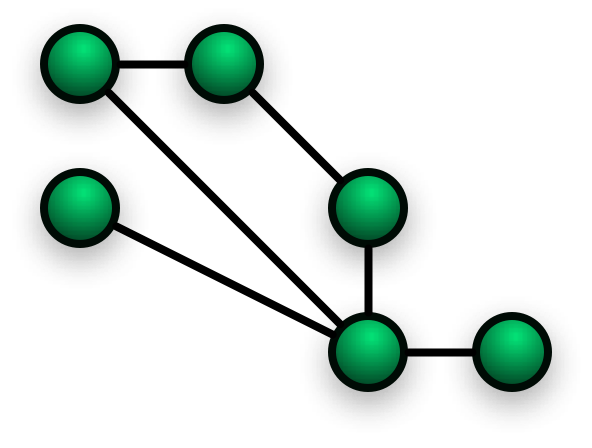
 Mesh networking is a type of networking wherein each node in the network may act as an independent router, regardless of whether it is connected to another network or not. It allows for continuous connections and reconfiguration around broken or blocked paths by “hopping” from node to node until the destination is reached.To the left is a partial mesh. There's also another one called a fully connected network.
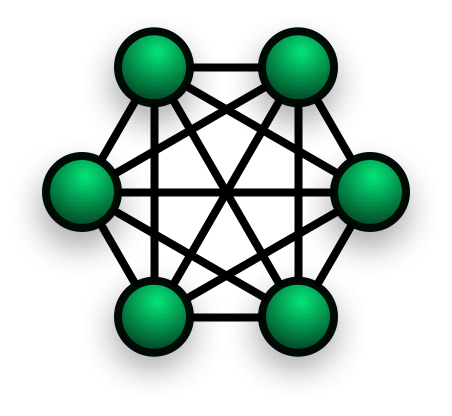
 A fully connected network is a communication network in which each of the nodes is connected to each other. A fully connected network doesn't need to use switching nor broadcasting. However, its major disadvantage is that the number of connections grows quadratically with the number of nodes, per formula
5. Tree
 Also known as a hierarchical network.
The type of network topology in which a central 'root' node (the top level of the hierarchy) is connected to one or more other nodes that are one level lower in the hierarchy (i.e., the second level) with a point-to-point link between each of the second level nodes and the top level central 'root' node, while each of the second level nodes that are connected to the top level central 'root' node will also have one or more other nodes that are one level lower in the hierarchy (i.e., the third level) connected to it, also with a point-to-point link, the top level central 'root' node being the only node that has no other node above it in the hierarchy (The hierarchy of the tree is symmetrical.) Each node in the network having a specific fixed number, of nodes connected to it at the next lower level in the hierarchy, the number, being referred to as the 'branching factor' of the hierarchical tree.This tree has individual peripheral nodes.
1.) A network that is based upon the physical hierarchical topology must have at least three levels in the hierarchy of the tree, since a network with a central 'root' node and only one hierarchical level below it would exhibit the physical topology of a star.
2.) A network that is based upon the physical hierarchical topology and with a branching factor of 1 would be classified as a physical linear topology.
3.) The branching factor, f, is independent of the total number of nodes in the network and, therefore, if the nodes in the network require ports for connection to other nodes the total number of ports per node may be kept low even though the total number of nodes is large – this makes the effect of the cost of adding ports to each node totally dependent upon the branching factor and may therefore be kept as low as required without any effect upon the total number of nodes that are possible.
4.) The total number of point-to-point links in a network that is based upon the physical hierarchical topology will be one less than the total number of nodes in the network.
5.) If the nodes in a network that is based upon the physical hierarchical topology are required to perform any processing upon the data that is transmitted between nodes in the network, the nodes that are at higher levels in the hierarchy will be required to perform more processing operations on behalf of other nodes than the nodes that are lower in the hierarchy. Such a type of network topology is very useful and highly recommended.
6. Peer-to-peer
Unfortunately, I don't really understand about this. I only have a vague understanding. In short, it's 2 computers connected, sharing resources. So, both PC are both server and client. That's as far as I understand. Sorry if I'm wrong.
Well, that's that. I had previoisly mentioned that I would post about anime, manga. But due to most of it being long, it'll take me a bit more time to write about it.
4. Mesh Networking

5. Tree

The type of network topology in which a central 'root' node (the top level of the hierarchy) is connected to one or more other nodes that are one level lower in the hierarchy (i.e., the second level) with a point-to-point link between each of the second level nodes and the top level central 'root' node, while each of the second level nodes that are connected to the top level central 'root' node will also have one or more other nodes that are one level lower in the hierarchy (i.e., the third level) connected to it, also with a point-to-point link, the top level central 'root' node being the only node that has no other node above it in the hierarchy (The hierarchy of the tree is symmetrical.) Each node in the network having a specific fixed number, of nodes connected to it at the next lower level in the hierarchy, the number, being referred to as the 'branching factor' of the hierarchical tree.This tree has individual peripheral nodes.
1.) A network that is based upon the physical hierarchical topology must have at least three levels in the hierarchy of the tree, since a network with a central 'root' node and only one hierarchical level below it would exhibit the physical topology of a star.
2.) A network that is based upon the physical hierarchical topology and with a branching factor of 1 would be classified as a physical linear topology.
3.) The branching factor, f, is independent of the total number of nodes in the network and, therefore, if the nodes in the network require ports for connection to other nodes the total number of ports per node may be kept low even though the total number of nodes is large – this makes the effect of the cost of adding ports to each node totally dependent upon the branching factor and may therefore be kept as low as required without any effect upon the total number of nodes that are possible.
4.) The total number of point-to-point links in a network that is based upon the physical hierarchical topology will be one less than the total number of nodes in the network.
5.) If the nodes in a network that is based upon the physical hierarchical topology are required to perform any processing upon the data that is transmitted between nodes in the network, the nodes that are at higher levels in the hierarchy will be required to perform more processing operations on behalf of other nodes than the nodes that are lower in the hierarchy. Such a type of network topology is very useful and highly recommended.
6. Peer-to-peer
Unfortunately, I don't really understand about this. I only have a vague understanding. In short, it's 2 computers connected, sharing resources. So, both PC are both server and client. That's as far as I understand. Sorry if I'm wrong.
Well, that's that. I had previoisly mentioned that I would post about anime, manga. But due to most of it being long, it'll take me a bit more time to write about it.
Network Topology 1
My next assignment, regarding network topology. I might make an Indonesian version. Anyway, here it is.
Network topology is the layout pattern of interconnections of the various elements (links, nodes, etc.) of a computer network. The types of network topology:
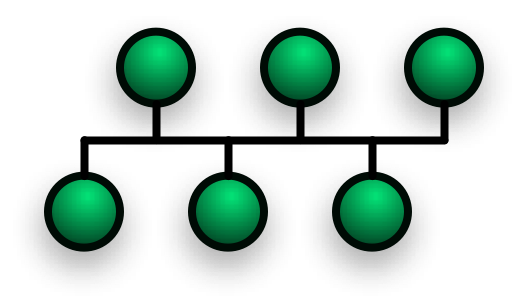
 A bus network topology is a network architecture in which a set of clients are connected via a shared communications line, called a bus.
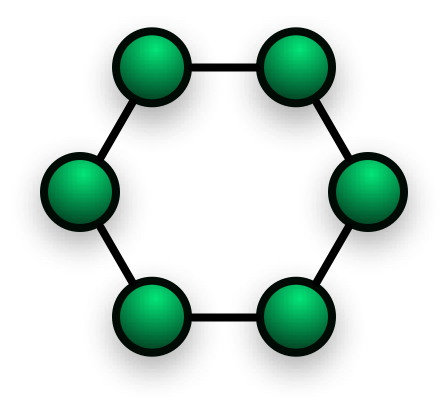
 A ring network is a network topology in which each node connects to exactly two other nodes, forming a single continuous pathway for signals through each node - a ring. Data travels from node to node, with each node along the way handling every packet.
 Star networks are one of the most common computer network topologies. In its simplest form, a star network consists of one central switch, hub or computer, which acts as a conduit to transmit messages. Thus, the hub and leaf nodes, and the transmission lines between them, form a graph with the topology of a star.
Network topology is the layout pattern of interconnections of the various elements (links, nodes, etc.) of a computer network. The types of network topology:
- Bus topology
- Star topology
- Ring topology
- Tree topology
- Mesh topology
Advantages
- Easy to implement and extend.
- Easy to install.
- Well-suited for temporary or small networks not requiring high speeds (quick setup), resulting in faster networks.
- Cheaper than other topologies.
- Cost effective; only a single cable is used.
- Easy identification of cable faults.
- Reduced weight due to fewer wires.
Disadvantages
- Limited cable length and number of stations.
- If there is a problem with the cable, the entire network breaks down.
- Maintenance costs may be higher in the long run.
- Performance degrades as additional computers are added or on heavy traffic (shared bandwidth).
- Proper termination is required (loop must be in closed path).
- Significant Capacitive Load (each bus transaction must be able to stretch to most distant link).
- It works best with limited number of nodes.
- Slower data transfer rate than other topologies.
- Only one packet can remain on the bus during one clock pulse.
Advantages
- Very orderly network where every device has access to the token and the opportunity to transmit
- Performs better than a bus topology under heavy network load
- Does not require network server to manage the connectivity between the computers
Disadvantages
- One malfunctioning workstation or bad port in the MAU can create problems for the entire network
- Moves, adds and changes of devices can affect the network
- Network adapter cards and MAU's are much more expensive than Ethernet cards and hubs
- Much slower than an Ethernet network under normal load
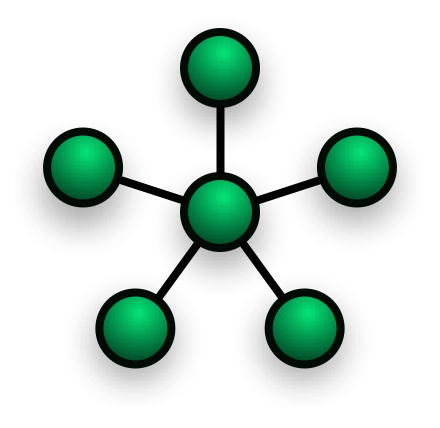
Advantages
- Better performance: star topology prevents the passing of data packets through an excessive number of nodes. At most, 3 devices and 2 links are involved in any communication between any two devices. Although this topology places a huge overhead on the central hub, with adequate capacity, the hub can handle very high utilization by one device without affecting others.
- Isolation of devices: Each device is inherently isolated by the link that connects it to the hub. This makes the isolation of individual devices straightforward and amounts to disconnecting each device from the others. This isolation also prevents any non-centralized failure from affecting the network.
- Benefits from centralization: As the central hub is the bottleneck, increasing its capacity, or connecting additional devices to it, increases the size of the network very easily. Centralization also allows the inspection of traffic through the network. This facilitates analysis of the traffic and detection of suspicious behavior.
- Simplicity: This topology is easy to understand, establish, and navigate. Its simplicity obviates the need for complex routing or message passing protocols. Also, as noted earlier, the isolation and centralization it allows simplify fault detection, as each link or device can be probed individually.
- Easy to install and wire.
- Easy to detect faults and to remove parts.
- No disruptions to the network when connecting or removing devices.
Disadvantages
- high dependence of the system on the functioning of the central hub
- failure of the central hub renders the network inoperable
- The performance and scalability of the network depends on the capabilities of the hub
- Network size is limited by the number of connections that can be made to the hub
- other nodes may see a performance drop if traffic to another node occupies a significant portion of the central node's processing capability or throughput.
- wiring up of the system can be very complex and expensive.
Subscribe to:
Posts (Atom)