
Network topology is the layout pattern of interconnections of the various elements (links, nodes, etc.) of a computer network. The types of network topology:
- Bus topology
- Star topology
- Ring topology
- Tree topology
- Mesh topology
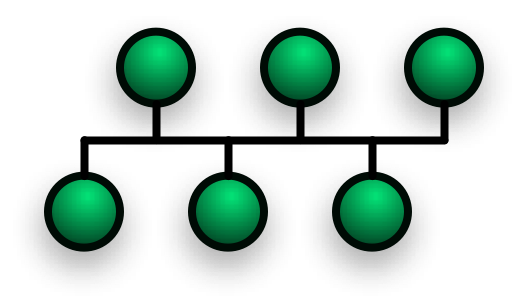
Advantages
- Easy to implement and extend.
- Easy to install.
- Well-suited for temporary or small networks not requiring high speeds (quick setup), resulting in faster networks.
- Cheaper than other topologies.
- Cost effective; only a single cable is used.
- Easy identification of cable faults.
- Reduced weight due to fewer wires.
Disadvantages
- Limited cable length and number of stations.
- If there is a problem with the cable, the entire network breaks down.
- Maintenance costs may be higher in the long run.
- Performance degrades as additional computers are added or on heavy traffic (shared bandwidth).
- Proper termination is required (loop must be in closed path).
- Significant Capacitive Load (each bus transaction must be able to stretch to most distant link).
- It works best with limited number of nodes.
- Slower data transfer rate than other topologies.
- Only one packet can remain on the bus during one clock pulse.
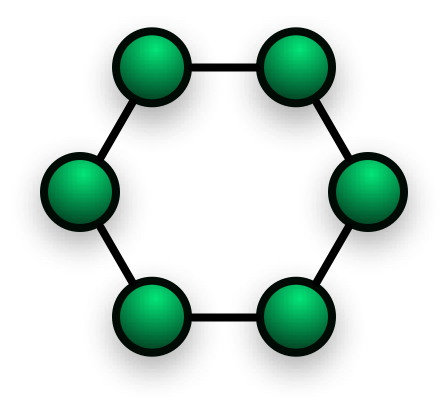
Advantages
- Very orderly network where every device has access to the token and the opportunity to transmit
- Performs better than a bus topology under heavy network load
- Does not require network server to manage the connectivity between the computers
Disadvantages
- One malfunctioning workstation or bad port in the MAU can create problems for the entire network
- Moves, adds and changes of devices can affect the network
- Network adapter cards and MAU's are much more expensive than Ethernet cards and hubs
- Much slower than an Ethernet network under normal load
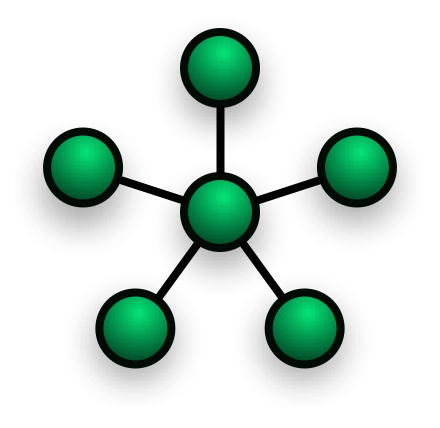
Advantages
- Better performance: star topology prevents the passing of data packets through an excessive number of nodes. At most, 3 devices and 2 links are involved in any communication between any two devices. Although this topology places a huge overhead on the central hub, with adequate capacity, the hub can handle very high utilization by one device without affecting others.
- Isolation of devices: Each device is inherently isolated by the link that connects it to the hub. This makes the isolation of individual devices straightforward and amounts to disconnecting each device from the others. This isolation also prevents any non-centralized failure from affecting the network.
- Benefits from centralization: As the central hub is the bottleneck, increasing its capacity, or connecting additional devices to it, increases the size of the network very easily. Centralization also allows the inspection of traffic through the network. This facilitates analysis of the traffic and detection of suspicious behavior.
- Simplicity: This topology is easy to understand, establish, and navigate. Its simplicity obviates the need for complex routing or message passing protocols. Also, as noted earlier, the isolation and centralization it allows simplify fault detection, as each link or device can be probed individually.
- Easy to install and wire.
- Easy to detect faults and to remove parts.
- No disruptions to the network when connecting or removing devices.
Disadvantages
- high dependence of the system on the functioning of the central hub
- failure of the central hub renders the network inoperable
- The performance and scalability of the network depends on the capabilities of the hub
- Network size is limited by the number of connections that can be made to the hub
- other nodes may see a performance drop if traffic to another node occupies a significant portion of the central node's processing capability or throughput.
- wiring up of the system can be very complex and expensive.

No comments:
Post a Comment